
How Much Technical Detail Should You Put in a Freelance Proposal?
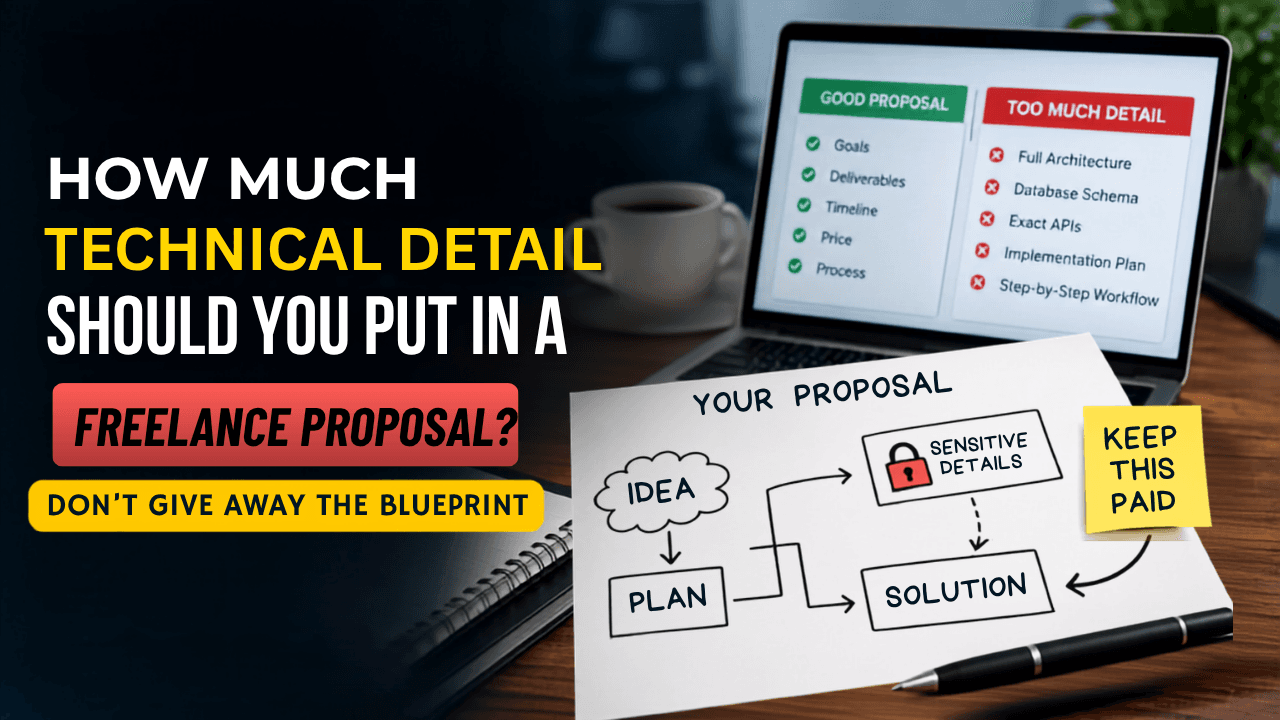
You spend hours on a proposal. You map the architecture. You list the APIs. You explain the workflows, the stack choices, the sequence of work. You want the client to see that you understand the project. You want them to feel confident.
Then they go quiet.
They come back.
They go quiet again.
Later they message you: they built it themselves using AI tools and no-code platforms. For a fraction of the price you quoted. And now they want hourly help fixing or extending it.
If that story makes your stomach drop a little, you may have seen some version of it yourself. The uncomfortable part is not only that the client walked away with the thinking. It is that the thinking was given away before any real commitment existed.
This is not a simple clients are bad story. Clients sometimes act poorly. Freelancers also sometimes give away too much unpaid work. The useful question is different: how much should you reveal before someone has actually hired you?
The Difference Between Selling Expertise and Giving Away the Plan
A proposal is meant to show that you understand the problem and can deliver a solution. It is not the same thing as a technical specification, an architecture document, or a full implementation plan.
Here is a practical way to separate the pieces:
Proposal: High-level description of the problem, the outcome the client wants, the main deliverables, rough phases, timeline estimate, and price.
Scope of work: Clear list of what is included and what is not, usually attached to a contract.
Discovery: Paid or unpaid early work to clarify requirements, risks, and approach.
Technical specification / architecture document: Detailed decisions about systems, APIs, data models, infrastructure, and edge cases.
Implementation: The actual building.
Most freelancers need the first two items before a client signs. The later items often have real commercial value on their own. When you put the later items into an unpaid proposal, you are essentially doing consulting for free.
What Usually Belongs in a Normal Proposal
You still need to show competence. A vague one-page note that says I can build your app for X dollars rarely wins serious work. The goal is enough detail to create confidence without creating a free blueprint.
Safe and useful elements often include:
A clear restatement of the client’s problem and desired outcome
High-level deliverables (for example: user dashboard, order management, driver assignment, reporting)
Project phases and rough timeline
Number of revision rounds
Pricing and payment milestones
General technology category when it matters (modern web stack with cloud backend rather than exact service names)
What the client will receive at the end
Assumptions and what is out of scope
These items help a serious client compare options and understand the shape of the work. They do not usually give away the hard thinking that turns a vague idea into a working system.
Detail That Often Belongs in Paid Work
Certain kinds of thinking are expensive and valuable. Once written down in detail, they can be reused by someone else.
Examples that frequently move into paid discovery or a separate technical phase:
Complete system architecture
Specific third-party services and exact API choices
Database schema design
Detailed authentication and authorization approach
Notification and messaging architecture
Infrastructure and deployment model
Detailed edge-case handling
Full comparison of alternative technical approaches
Production monitoring and scaling considerations
None of this is a universal rule. A simple brochure site or a straightforward WordPress build rarely needs paid discovery. A two-sided marketplace with video processing, payments, maps, and creator workflows is a different story. The more complex and uncertain the project, the more sense it makes to treat deep planning as billable work.
A Concrete Example
Imagine a client wants a delivery-management platform.
A solid unpaid proposal might say something like this:
“We will build a web dashboard and mobile views for managing delivery orders, assigning drivers, tracking status in real time, and generating basic reports. The work will be delivered in three phases over roughly twelve weeks. The price includes two rounds of revisions after each major milestone. Payment will be split across kickoff, mid-project, and final delivery.”
That shows understanding. It does not hand over the solution.
A paid discovery or technical specification document might later cover:
Choice of mapping provider and why
How real-time location updates will be handled
Database design for orders, drivers, and status history
Authentication approach for drivers versus admin users
Notification system (push, SMS, email)
Deployment and environment setup
How the system will handle offline drivers or failed payments
That second document is valuable work on its own. It may take hours of research, testing, and technical thinking to produce.
How AI Tools Changed the Risk
AI coding tools and no-code platforms have lowered the barrier for a motivated person to turn a clear technical plan into a rough prototype. That is real. It does not mean AI replaces experienced developers.
A prototype that looks impressive in a demo can still fail on security, edge cases, performance under load, reliable payments, data integrity, long-term maintenance, proper testing, monitoring, and clean handoff. Real products usually need someone who understands the trade-offs and can keep the system healthy over time.
The practical point for freelancers is simpler: a detailed technical blueprint now has more immediate value to someone who wants to try building it themselves. That does not make AI the villain. It means the old habit of giving away complete architecture in an unpaid proposal carries higher risk than it did a few years ago.
Some freelancers have started treating AI-assisted prototype rescue as a possible service, often at higher rates because the resulting code can be difficult to maintain. Others simply decline. Both approaches can be rational depending on your business model and tolerance for risk.
Why Some Detail Still Helps
Being too vague has its own costs. Serious clients often need enough information to compare vendors, estimate internal effort, or get internal approval. A proposal that only says I will solve your problem can feel empty.
Useful detail can:
Build trust
Demonstrate that you understand the domain
Reduce later misunderstandings about scope
Help the client plan their own side of the work
Filter out people who are not ready to buy
The skill is knowing when the detail has crossed from “showing competence” into “doing the actual planning work for free.”
Practical Red Flags During Sales
Not every question is a warning sign. Clients are allowed to ask how you would approach the work. The difference is pattern and intensity.
Watch for combinations such as:
Repeated requests for more and more technical depth with no movement toward a contract or deposit
Asking several freelancers for extremely detailed plans at the same time
Refusing any form of paid discovery while demanding architecture-level answers
Focusing almost exclusively on exactly how would you build this before any commercial discussion
Long periods of silence followed by sudden returns asking for free revisions or more detail
A client who asks thoughtful questions and then moves toward a clear next step is usually doing normal due diligence. A client who treats the sales process as free consulting is a different situation.
A Simple Process Many Freelancers Use
One workable sequence looks like this:
Short conversation to understand the problem and filter obvious mismatches.
High-level proposal focused on outcomes, deliverables, timeline, and price.
If the project is complex or requirements are unclear, offer a paid discovery phase.
After discovery, deliver a clearer technical plan or specification.
Then propose the full implementation with defined milestones.
Not every project needs every step. For smaller or well-defined work, steps 1 and 2 are often enough. For larger or ambiguous work, inserting paid discovery protects your time and often produces a better project for both sides.
Some freelancers also keep a short list of qualifying questions they ask before investing serious proposal time. Simple questions about budget range, decision timeline, previous attempts to build the product, and who will own the project internally can save many unpaid hours.
What Should You Actually Put in a Freelance Proposal?
A practical framework:
Focus on the outcome and the boundaries.
Describe what the client will be able to do when the work is finished. List the major pieces that will be delivered. State what is not included. Give a realistic timeline and a clear price structure.
Keep the “how” at a high level.
You can say you will use a modern cloud backend and a reliable payment provider. You do not need to name every service, design the database tables, or write the sequence of API calls in the unpaid document.
Separate selling from solving.
The proposal sells your ability to solve the problem. The detailed solving happens after the client has committed, usually through discovery or the early project phases.
Match the depth to the project.
A $2,000 brochure site does not need the same process as a $40,000 platform. Adjust the amount of unpaid thinking accordingly.
Protect your time with process, not secrecy.
You do not need to become mysterious or difficult. You simply stop treating deep technical planning as a free gift that comes with every inquiry.
Action Plan You Can Use This Week
Before writing the next detailed proposal, ask a few better qualifying questions.
Write the first proposal around outcomes, deliverables, phases, and price.
Move architecture, exact tool selection, and detailed workflows into a paid discovery offer when the project is complex.
Use clear payment milestones so both sides have skin in the game early.
Decide in advance how many unpaid hours you are willing to spend on any single prospect.
Keep simple records of what was discussed and what was shared.
Treat AI tools as helpers for your own productivity. Do not let the ease of generating documents convince you that your professional judgment is free.
When a client returns later with an AI-built prototype and asks for cheap hourly help, decide based on your current capacity and the true cost of cleaning up the work, not on leftover frustration.
The goal is not to become rigid or unfriendly. The goal is to stop automatically giving away the most valuable part of your work before the client has committed.
Freelancers who learn this boundary usually lose fewer hours to tire-kickers and keep more energy for the clients who are ready to build something real. The proposal still needs to be good enough to win the work. It does not need to be the complete instruction manual.
FAQ
How detailed should a freelance proposal be?
Enough to show you understand the problem, the main deliverables, the rough timeline, and the price. Avoid complete architecture, exact API lists, database schemas, and full implementation sequences unless those are part of a paid discovery phase.
Should freelancers charge for discovery?
For complex or unclear projects, yes. Discovery that produces useful technical decisions has real value. For simple, well-defined work, a normal proposal is often sufficient.
Can a client use my proposal with another developer?
In practice they sometimes do. That is one reason many freelancers keep unpaid proposals high-level and move detailed planning behind a contract or paid discovery. Exact legal rights depend on the agreement and jurisdiction; get proper advice for large or disputed situations.
What should I include in a software development proposal?
Problem statement, desired outcomes, high-level deliverables, phases, timeline estimate, pricing and milestones, assumptions, and what is out of scope. Keep exact technical choices at a general level until the client has committed.
How can freelancers protect their time during sales?
Qualify prospects early, limit unpaid proposal hours, offer paid discovery for complex work, and focus proposals on outcomes rather than complete blueprints.
Should I include the exact technology stack in a proposal?
Usually no. Naming the general category is often enough. Specific service choices and architecture decisions frequently belong in paid work.
Is paid discovery worth it for small projects?
Often not. For small, clear projects the overhead can outweigh the benefit. For larger or ambiguous work it usually is.
Has AI changed how freelancers should write proposals?
It has increased the risk of detailed technical plans being turned into prototypes by the client. The core principle stays the same: show enough expertise to win the work, but do not automatically hand over the complete implementation thinking for free.
Suggested Internal Links
Freelance proposal template and structure
How to run a paid discovery phase
Setting payment milestones for freelance projects
Qualifying clients before writing long proposals
Scope of work vs proposal: what is the difference
Handling clients who return with AI-built prototypes
Sources / Reference Note
This article was inspired by discussions among freelancers about unpaid proposals, technical planning, client qualification, and the changing role of AI tools in software development.